DeepLense-SR: Advancing Analysis for LSST & Euclid Surveys
ML4Sci GSoC 2026 Preparation
Upcoming surveys like Euclid and LSST are predicted to discover over 100,000 strong lenses. However, many of these systems will have small Einstein radii ($\theta_E < 1"$) that are barely resolved at survey resolution.
DeepLense-SR applies physics-informed machine learning to enhance these images, recovering sub-pixel details critical for:
Select a sample from the left to explore different reconstruction methods.
Select a sample to see details about the lens configuration.
Comparison of average performance across the validation set.
| Method | Arc Sharpness Score | Ring Contrast Ratio | Training Signal |
|---|---|---|---|
| Bicubic Interpolation | 221.96 | 5.08 | N/A |
| SR Baseline (Supervised) | 268.50 | 4.97 | HR labels |
| SR Hybrid (Physics-Informed) | 267.41 | 5.39 | Sup + Physics. Highest contrast. |
| Unsupervised (Physics-Only) | 249.40 | 4.83 | Physics only. TV Regularized. |
| HR Ground Truth | 266.39 | 5.14 | Target |
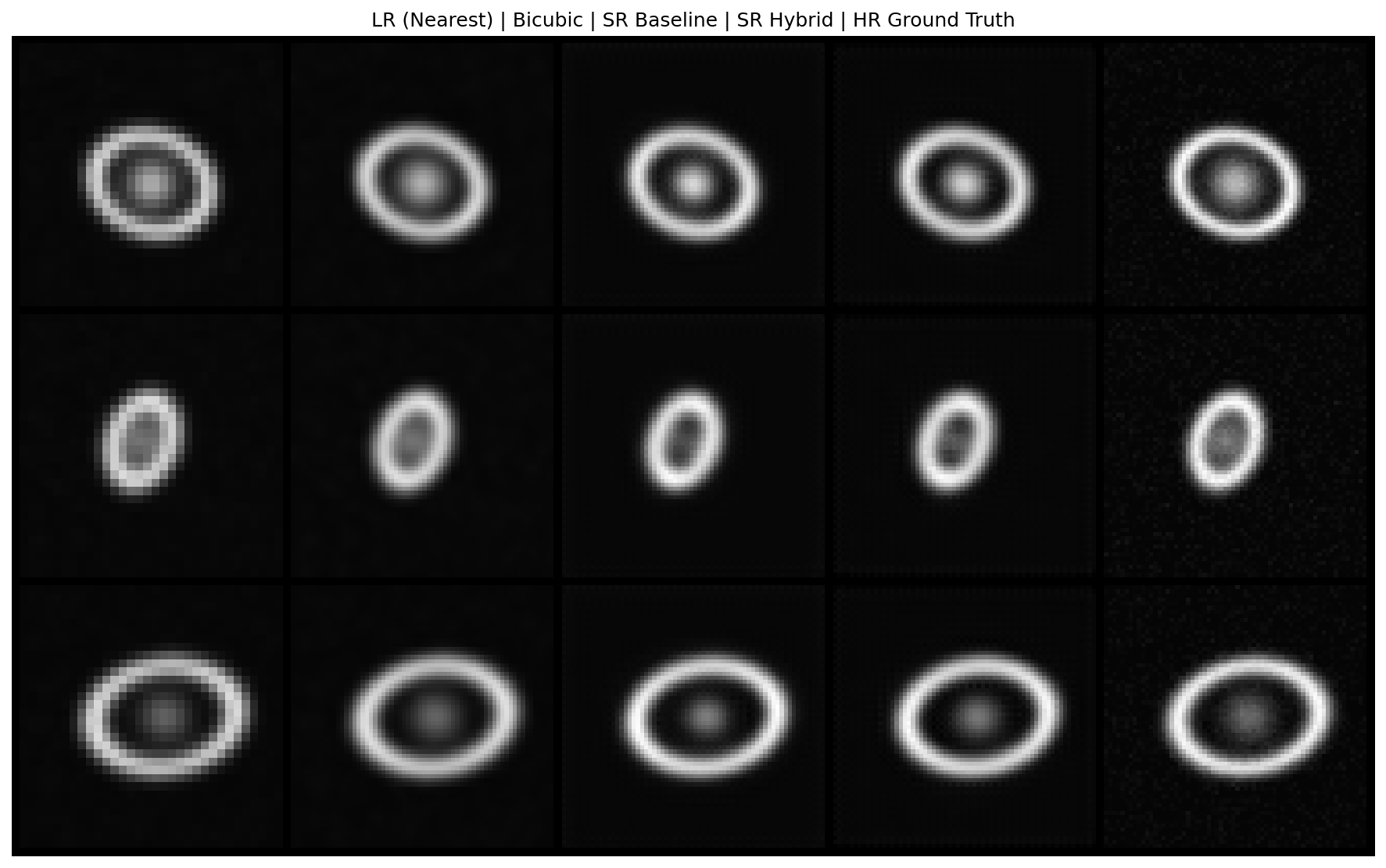
Qualitative comparison showing arc sharpness and ring continuity.
Left to Right: Low Res, Bicubic, SR Baseline, SR Hybrid, High Res (Ground Truth)
*(Note: Unsupervised not shown in standard validation grid)*